


In our previous discussion on DePIN infrastructure, we looked at how decentralized networks can monetize active hardware like sensors and 5G nodes. But what about the most traditional asset of all? The buildings themselves.
In 2026, Tokenized Real Estate has moved from a niche crypto experiment to a mainstream financial standard. By converting property rights into digital tokens on a blockchain, businesses can finally treat their physical locations as liquid capital. This transition is powered by the same Agentic FinTech systems that manage your day-to-day cash flow, turning “bricks and mortar” into a dynamic part of your Akcache strategy.
The Liquidity Problem in Traditional Real Estate
Historically, real estate has been a “dead” asset. If you owned a $5 million warehouse, that money was trapped. If you needed $500,000 for a new project, you had to take out a mortgage, pay high bank fees, and wait weeks for approval.
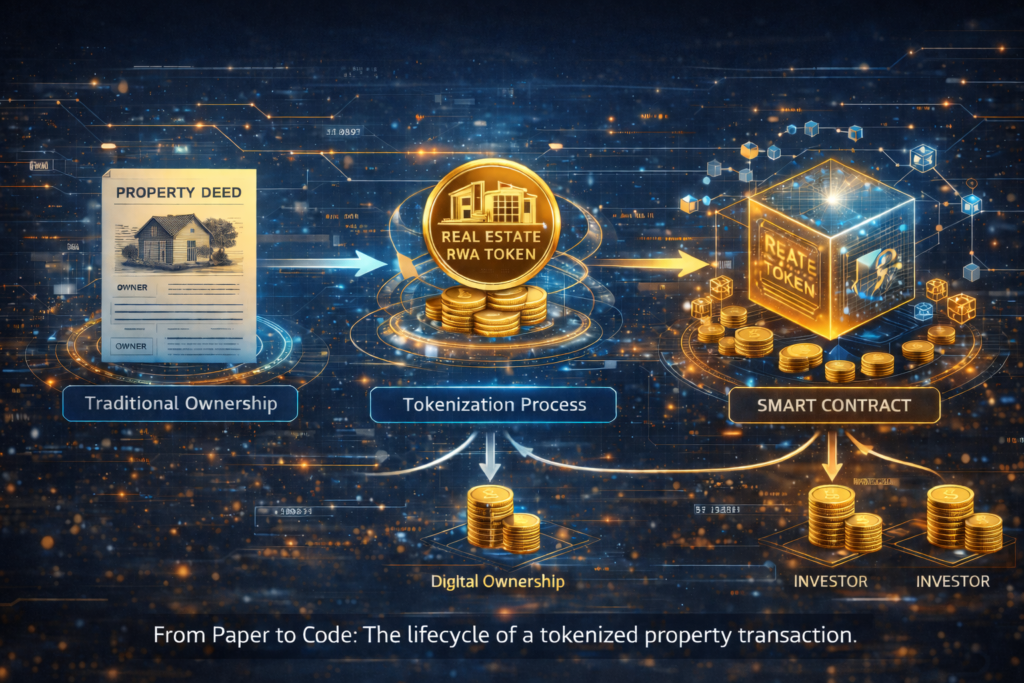
Tokenization solves this by allowing for fractional ownership. Instead of selling the whole building, you can tokenize 10% of it. This 10% can be sold to investors or used as collateral in a DeFi liquidity pool. Because the ownership is on-chain, the transaction takes seconds, not months.
The Power of Smart Legal Contracts (SLC)
The backbone of this revolution is the Smart Legal Contract (SLC). Unlike early smart contracts that only handled simple data, 2026-era SLCs are legally binding documents recognized by courts. They bridge the gap between digital tokens and the local land registry.
These contracts are “self-executing.” They contain the rules of the property—who gets paid rent, how maintenance is funded, and how taxes are filed. When an AI agent manages your autonomous treasury, it interacts directly with these SLCs to ensure your property is always generating a return.
1. Automated Rental Distribution
In a tokenized building, rent is paid in stablecoins. The moment the tenant pays, the smart contract splits the payment instantly between all token holders. There is no property manager taking a 10% fee just to move money from one bank to another. This is the ultimate form of business efficiency.
2. Programmable Maintenance Funds
Smart contracts can be programmed to hold a portion of the rent in a “Maintenance Vault.” If a sensor in the building (connected via DePIN infrastructure) detects a leak or a failure, the smart contract can automatically release funds to a pre-approved contractor. The repair is paid for and fixed before you even receive a notification on your dashboard.
Real Estate as a “Collateral Layer” for Business Loans
One of the most exciting developments in 2026 is using tokenized property to secure AI-driven business loans. Traditional lenders look at your credit score; modern lenders look at your On-Chain Equity.
If you own a tokenized office space, you can “lock” those tokens into a smart contract as collateral. An AI lender can instantly verify the value of the property and your ownership through Zero-Knowledge Proofs, granting you a loan at a much lower interest rate than a traditional bank. Your real estate isn’t just where you work; it’s your primary financial tool.
The Synergy: DePIN Meets Real Estate
This is where your DePIN infrastructure becomes truly powerful. A “Smart Building” in 2026 isn’t just a structure; it’s a DePIN node.
- Your rooftop hosts solar panels that trade energy on the grid.
- Your basement hosts decentralized data servers.
- Your exterior hosts 5G mesh nodes.
All of these hardware assets generate revenue. When you tokenize the building, the investors aren’t just buying the land; they are buying a share of the DePIN revenue generated by that building. This increases the property’s valuation and makes your tokens much more attractive on the open market.
Regulatory Clarity and ZKP Privacy
In the past, people worried about the legal side of tokenization. Today, the integration of Zero-Knowledge Proofs (ZKP) allows you to prove you are a compliant, tax-paying owner without exposing your entire investment portfolio to the public. You can maintain the privacy of your business operations while still benefiting from the transparency of the blockchain. This “Privacy-First” approach is what makes institutional investors comfortable entering the tokenized RWA space.
Conclusion: The Final Pillar of the Akcache Strategy
With the addition of Tokenized Real Estate, your website now covers the entire spectrum of 2026 finance:
- Credit: How to get funded via AI.
- Operations: How to automate with Agentic FinTech.
- Liquidity: How to harvest yield in DeFi.
- Hardware: How to scale with DePIN.
- Stability: How to secure wealth in Tokenized Property.
The future of business isn’t about owning more “things”; it’s about owning more “liquid assets.” By tokenizing your real estate, you are ensuring that your company is ready for the high-speed, autonomous economy of tomorrow.
