
In our recent analysis of Quantum Liquidity, we established that the speed of capital is the new gold standard. However, speed without structure is a recipe for chaos. As businesses move toward recursive capital loops, the traditional methods of “Corporate Governance”—board meetings, manual minutes, and expensive legal audits—have become the ultimate bottleneck.
We are entering the era of Synthetic Governance. This is not just a digital version of a law book; it is a system where the rules of the company are embedded directly into its operational protocols. At Akcache, we define this as the “Final Layer of Sovereignty”—a business that governs itself.
The Three Pillars of Automated Authority
To transition from a manual firm to a synthetic one, a founder must restructure how decisions are made, verified, and executed. This requires moving beyond “handshake deals” and into the realm of Self-Executing Authority.
1. Programmable Voting and Consensus
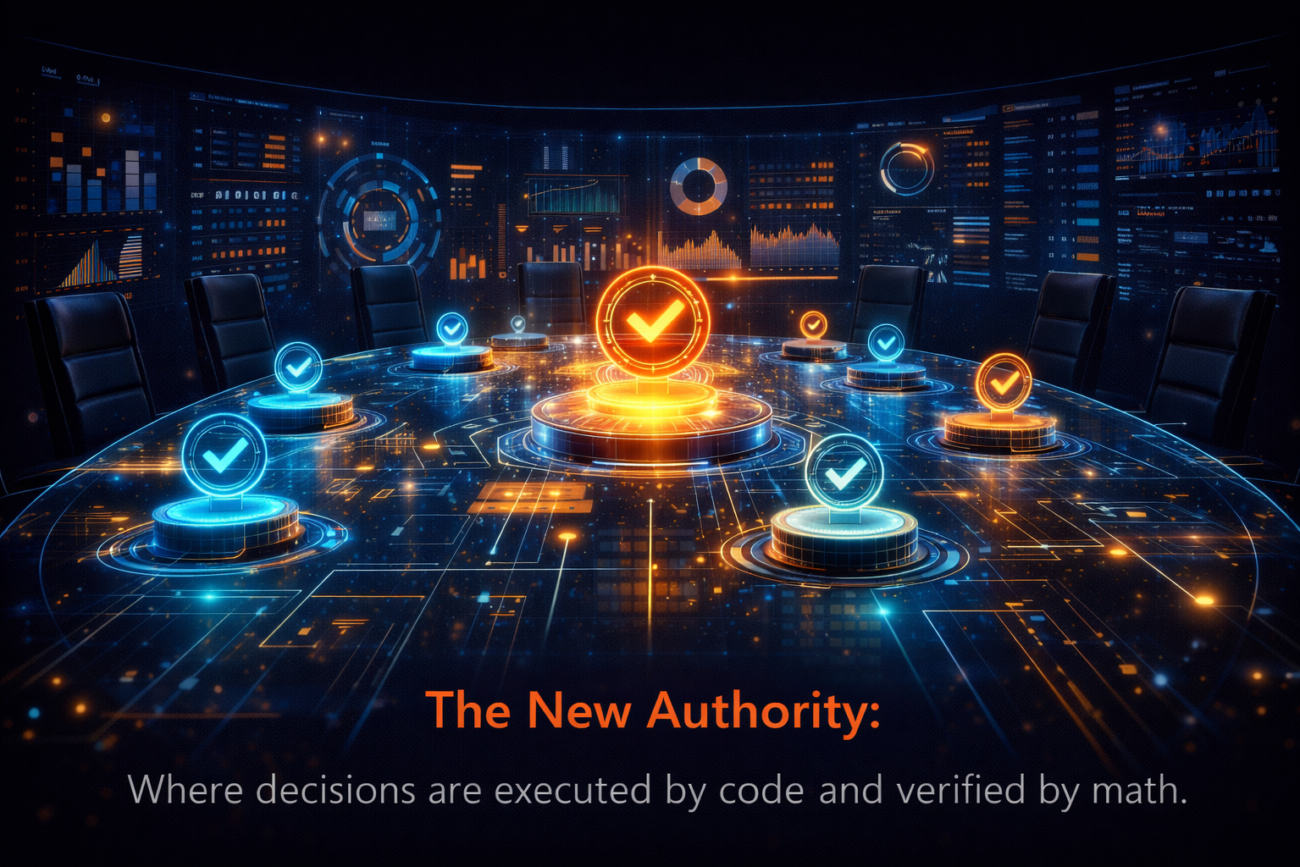
Traditional shareholder voting is slow, prone to manipulation, and expensive to verify. With Synthetic Governance, your programmable equity serves as your voting power. When a major decision is required—such as an M&A exit—the vote happens on-chain. The moment the threshold is met, the decision is not just “recorded”; it is executed by a smart contract.
2. Autonomous Compliance Audits
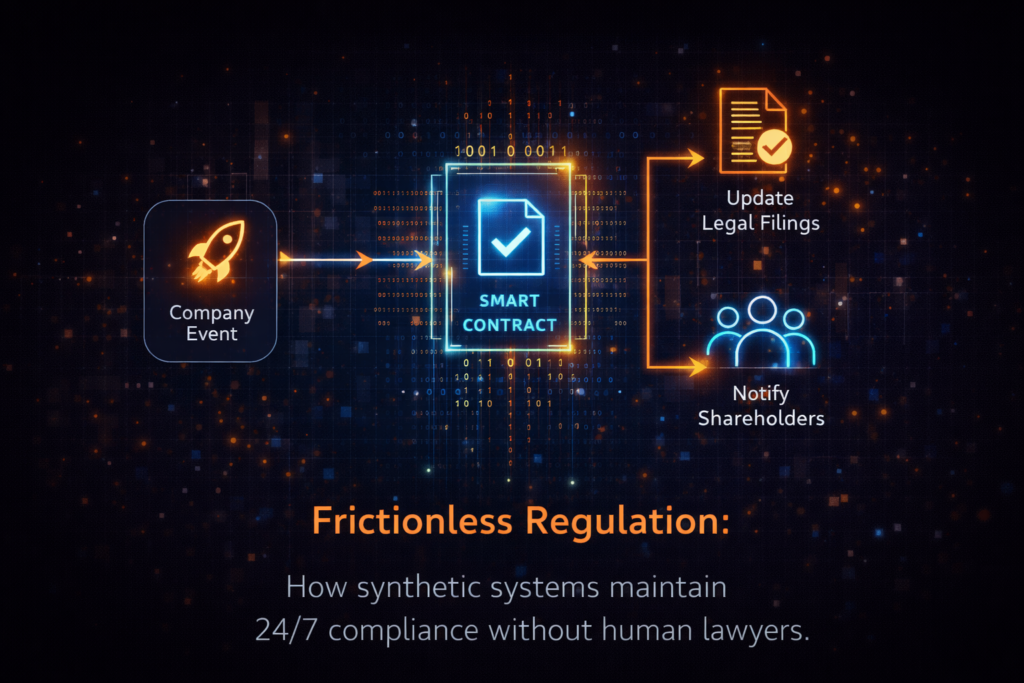
In the old economy, compliance was something that happened once a quarter during an audit. In a synthetic system, compliance is Continuous. Your algorithmic tax agents and revenue integrity protocols are constantly feeding data into a governance layer. If a transaction violates a pre-set legal parameter, it is blocked instantly. This creates a “Bulletproof Balance Sheet” that is always audit-ready.
Weaponizing Trust: The Synthetic Advantage
The true power of Synthetic Governance is that it builds institutional trust at a scale that was previously impossible for mid-sized firms.
- Eliminating the “Founders Risk”: Investors and private credit providers are often wary of “Key Man Risk.” By using synthetic protocols, you prove to your partners that the business follows a set of immutable rules. This lowers your refinancing interest rates because the risk of human mismanagement is mathematically removed.
- Global Scaling with Local Precision: If your DePIN infrastructure operates across twelve countries, a synthetic system can automatically adjust its governance rules to match each local jurisdiction. It ensures that your supply chain finance remains legal and liquid, regardless of where the physical hardware is located.
The Privacy of the Synthetic Sovereign
In a transparent world, the greatest defense is Selective Disclosure. While the rules of your governance are public and verifiable, the details of your strategy must remain your own.
We achieve this through Zero-Knowledge Governance. By utilizing privacy-preserving protocols, you can prove to a regulator that your board voted to approve a new debt issuance without revealing the names of the board members or the specific strategic goals discussed. You provide the “Proof of Consensus” without surrendering your “Competitive Moat.”
The Horizon: From Hierarchy to Protocol
Building a business on Synthetic Governance is the ultimate goal of the Infinite Balance Sheet. It is the transition from a “top-down” hierarchy to a “protocol-first” organization.
At Akcache, we believe that the only way to scale a business to its true potential is to remove the human friction from the core logic. When your governance is synthetic, your business becomes a “Living Protocol” that can grow, adapt, and protect itself. You are no longer just a manager; you are the architect of a self-sustaining system.
Conclusion: The Architecture of Trust
The future of business is not found in the courtroom; it is found in the code. By aligning your real estate equity and your digital capital with synthetic protocols, you build a fortress of trust that is impossible to penetrate.
The transition to Synthetic Governance is the final step toward true financial sovereignty. It is time to let the code lead.
