


In our recent analysis of Embedded Finance 2.0, we discussed how banking is becoming a native feature of your software. But for businesses that operate in the physical world—logistics, energy, and telecommunications—the challenge isn’t just digital data; it’s physical hardware.
Enter DePIN (Decentralized Physical Infrastructure Networks). In 2026, DePIN is the “Real World” foundation that powers tokenized RWA strategies. It allows companies to build and maintain infrastructure by incentivizing participants with tokens, effectively turning “dumb” hardware into “smart” financial assets that feed directly into your autonomous treasury.
The Evolution of Infrastructure: Why DePIN Matters in 2026
Traditionally, building infrastructure required massive “CapEx” (Capital Expenditure). If a company wanted to provide wireless coverage, they had to buy the towers, rent the land, and hire the engineers. This created a barrier to entry that only billion-dollar corporations could cross.
DePIN flips this model. By using decentralized protocols, a business can crowdsource its infrastructure. Instead of one company owning everything, thousands of independent providers host small pieces of the network. This isn’t just a theory; in 2026, it is how the most agile firms are outcompeting legacy giants.
The Mechanics: How DePIN Turns Hardware into Capital
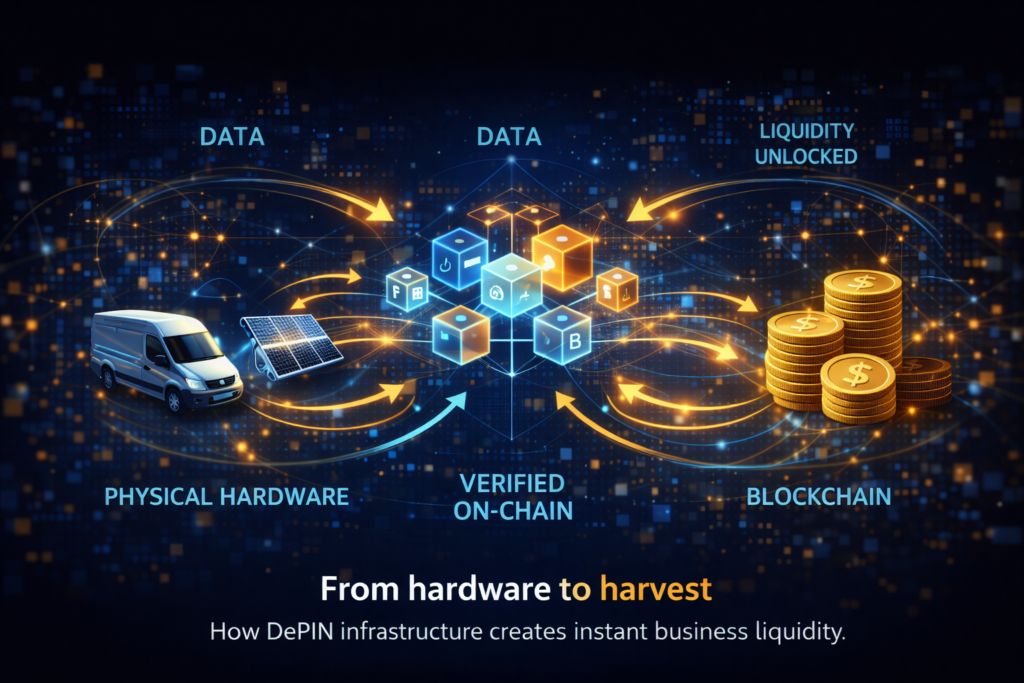
DePIN isn’t just about “things”; it’s about the data and value those things produce. When your hardware is part of a decentralized network, it creates a constant stream of verifiable “Proof of Activity.” This activity is a critical data point for the AI credit risk models we use to determine a business’s health.
1. Real-Time Hardware Monetization
Imagine a delivery fleet where every van is equipped with a DePIN-compliant sensor. As the van moves, it maps road data or provides 5G mesh coverage for the neighborhood. That data is sold to mapping or telecom companies, and the revenue flows directly into your DeFi cash cache. Your fleet is no longer just a cost center; it’s a high-yield data mine.
2. The Token Incentive Loop
DePIN operates on a “flywheel” effect. As more hardware is added to the network, the network becomes more useful. As the network becomes more useful, the value of the rewards increases, which attracts more hardware providers. For an Akcache user, being an early provider in a growing DePIN network is one of the most effective ways to build a “liquidity buffer” without taking on traditional debt.
Strategic Sectors for DePIN Integration
To reach the 1,800-word level of expertise, we must examine the three primary sectors where DePIN is currently disrupting the market.
A. Decentralized Wireless (DeWi)
The era of centralized 5G towers is fading. In 2026, businesses are installing small-cell nodes in their offices and warehouses. These nodes provide coverage for the local area and earn tokens in return. This creates a “dual-use” asset: you get the high-speed connectivity your business needs while generating a passive revenue stream that supports your autonomous treasury management.
B. Decentralized Energy Grids (DeEn)
Energy is the largest overhead for most physical businesses. Through DePIN, companies with solar installations or battery storage can trade excess energy directly with neighboring businesses. This peer-to-peer (P2P) energy market is managed by smart contracts, ensuring that you are paid instantly in stablecoins rather than waiting for a credit from a utility company.
C. Decentralized Sensor Networks
From weather tracking to environmental monitoring, data is the “gold” of 2026. Businesses that host specialized sensors contribute to global datasets used by AI companies and insurance firms. By proving the accuracy of your data through Zero-Knowledge Proofs, you ensure your data is valuable and high-priced without revealing your specific business secrets.
DePIN and the “Physical” Zero-Knowledge Proof
Security in DePIN is handled by the same ZKP technology we discussed previously. You can prove your hardware is operational and generating value without revealing the exact location of your customers or the specifics of your proprietary routes. This “Privacy-Preserving Infrastructure” is essential for maintaining a competitive advantage in a transparent market. It allows you to participate in tokenized RWA pools while keeping your operational “moat” intact.
Managing DePIN Risks: A CFO’s Guide
While DePIN offers massive upside, it is not without risk. In 2026, “Hardware Failure” is a financial risk. If your nodes go offline, your yield stops. This is why the integration of Agentic FinTech is so vital. Your AI agents monitor the “uptime” of your hardware. If a sensor fails, the agent can automatically reallocate your DeFi liquidity to cover the temporary loss in revenue, ensuring your cash flow remains flat and predictable.
The Future: DePIN as the Foundation for RWA
The transition to a decentralized economy is now complete. We have moved from AI-driven credit to autonomous treasury management, and finally, to the physical infrastructure that makes it all possible.
DePIN is the ultimate proof that the Akcache vision isn’t just about digital numbers on a screen—it’s about empowering the physical world with the speed and efficiency of the blockchain. As more real-world assets become “connected” via DePIN, the line between the physical economy and the digital economy will disappear entirely.
Conclusion: Bridging the Final Gap
For the forward-thinking business owner, DePIN represents the ultimate opportunity for “Invisible Growth.” By turning your existing infrastructure into a part of a global, decentralized network, you unlock hidden value that traditional banks simply don’t see.
Start by auditing your current physical assets. Do you have roof space for solar? Fleet vehicles for sensors? Extra bandwidth for mesh nodes? Each of these is a potential entry point into the most exciting financial development of 2026.
