

Global trade has always been plagued by a fundamental timing problem: a manufacturer needs capital to build a product today, but the buyer won’t pay for that product for 60 or 90 days. Traditionally, this “Liquidity Gap” was filled by expensive factoring services or slow bank lines of credit.
In 2026, we have moved past these manual barriers. By integrating AI revenue leakage prevention, businesses are now using real-time data to unlock “Just-in-Time Liquidity.” This is the core of AI Supply Chain Finance, a system where capital flows as fast as the goods move.
The Problem with Traditional Trade Finance
Historically, trade finance was built on paper. Bills of lading, letters of credit, and physical invoices created a massive administrative burden. If a supplier in one country needed funds, a bank in another country had to verify the shipment manually—a process that could take weeks.
For an Akcache user, this delay is unacceptable. While you may have equity in tokenized real estate, using that equity to fund a production run shouldn’t require a mountain of paperwork. AI is the bridge that turns physical trade data into immediate financial confidence.
The Mechanics of Autonomous Trade Finance
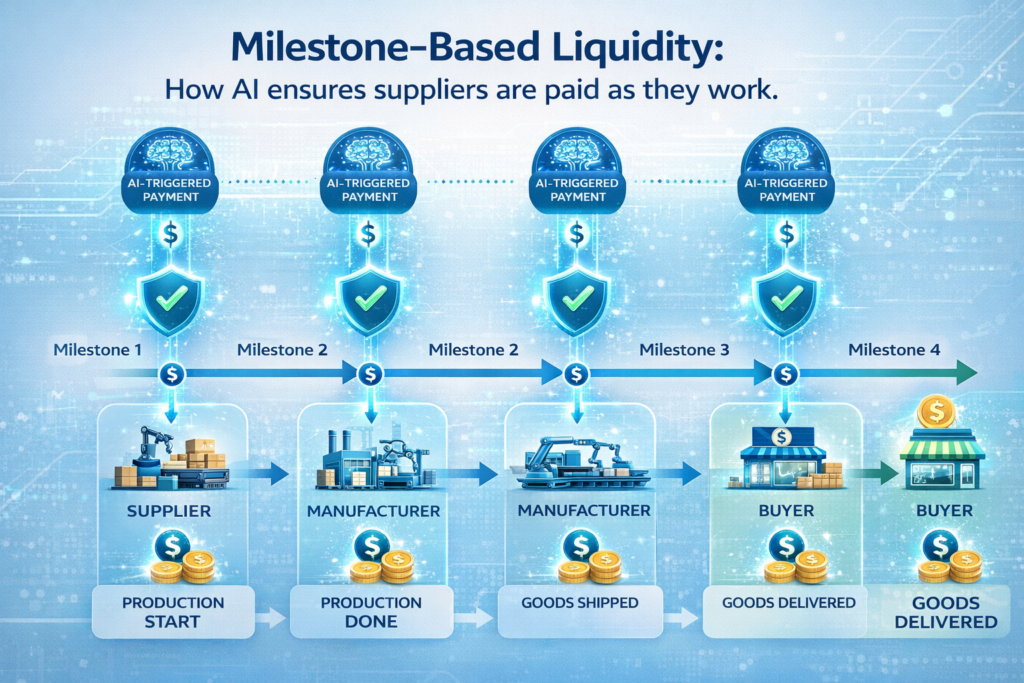
In 2026, supply chain finance is driven by “Event-Triggered Liquidity.” Using IoT sensors and DePIN infrastructure, an AI agent can verify that a shipment has left a warehouse or reached a port. This verification triggers an immediate release of funds through a smart contract.
1. Dynamic Deep-Tier Financing
One of the biggest breakthroughs in 2026 is “Deep-Tier” financing. Usually, only the main supplier gets access to credit. But with AI, the “Supplier of the Supplier” can also be financed. The AI agent analyzes the entire chain’s revenue integrity and provides credit based on the strength of the final buyer’s purchase order.
2. Predictive Inventory Funding
Why wait for an order to arrive before seeking funding? AI models now predict demand cycles with 98% accuracy. If the AI predicts a surge in demand for your product next month, it can automatically secure a tokenized business loan to help you stock up on raw materials before prices rise.
Leveraging Real Assets for Trade Liquidity
The synergy between different asset classes is what makes the 2026 fintech ecosystem so powerful.
Real Estate as a Liquidity Anchor
For many manufacturing businesses, their warehouse or factory is their most valuable asset. By using tokenized real estate, you can use the “Equity Tokens” of your building as a secondary collateral layer for your supply chain loans. This lowers your interest rate because the lender has a high-security, physical asset backing the trade.
Revenue Leakage and Creditworthiness
Lenders in 2026 look at more than just a balance sheet; they look at your operational precision. If your AI revenue leakage prevention system shows that your business captures 100% of its earned income with zero billing errors, your “Risk Score” drops significantly. This “Operational Excellence” is a primary factor in securing low-interest trade credit.
Security through Zero-Knowledge Proofs (ZKP)
A major hurdle in global trade is the sharing of sensitive supply chain data. You don’t want your competitors to know exactly who your suppliers are or what prices you are paying.
Through ZKP technology, you can prove to a trade finance protocol that you have a valid, $1 million purchase order from a reputable buyer without revealing the buyer’s name or the specific product details. You get the liquidity you need while keeping your competitive secrets safe.
The Future: From Supply Chains to Value Webs
As we move toward the end of 2026, the concept of a “chain” is being replaced by a “Value Web.” In this model, every participant—from the raw material provider to the final retailer—is connected to a single AI-driven financial layer.
This layer manages:
- Currency Risk: Automatically hedging foreign exchange exposure using DeFi protocols.
- ESG Compliance: Verifying that suppliers meet environmental standards via DePIN sensor data.
- Fraud Prevention: Using AI to detect “double-invoicing” or phantom shipments.
Conclusion: The Liquid Global Business
Supply chain finance is no longer a luxury for Fortune 500 companies. With the tools available at Akcache, even mid-sized businesses can operate with the financial sophistication of a global bank. By stopping revenue leakage and leveraging your tokenized property, you create a business that is not just productive, but perfectly liquid.
The goal is simple: ensure that capital is never the bottleneck for your growth.
