



Even with the most advanced AI debt refinancing strategies, a business can still fail if it is losing money through the “cracks” of its daily operations. Industry data in 2026 shows that the average mid-sized company loses between 2% and 5% of its total revenue to “leakage”—errors in billing, uncollected payments, and contract non-compliance.
At Akcache, we view revenue integrity as the foundation of a healthy autonomous treasury. If you aren’t capturing every dollar you earn, you aren’t maximizing the capital available for DeFi yield or DePIN scaling.
What is Revenue Leakage in the AI Era?
Revenue leakage is any earned income that is not successfully collected or realized due to operational inefficiencies. In the past, this was caused by manual data entry errors or missed emails. In 2026, the complexity of embedded finance and multi-chain payments has created new types of leakage.
Common “Leakage Points” include:
- Billing Latency: Delays between service delivery and invoice generation.
- Siloed Data: Accounting software not communicating with project management tools.
- Contract Mismatches: Charging a client a legacy rate when a new smart legal contract has already updated the pricing.
The Mechanics of AI Revenue Integrity
In 2026, businesses are deploying “Revenue Integrity Agents.” These are specialized Agentic FinTech tools that act as a 24/7 internal auditor for your business.
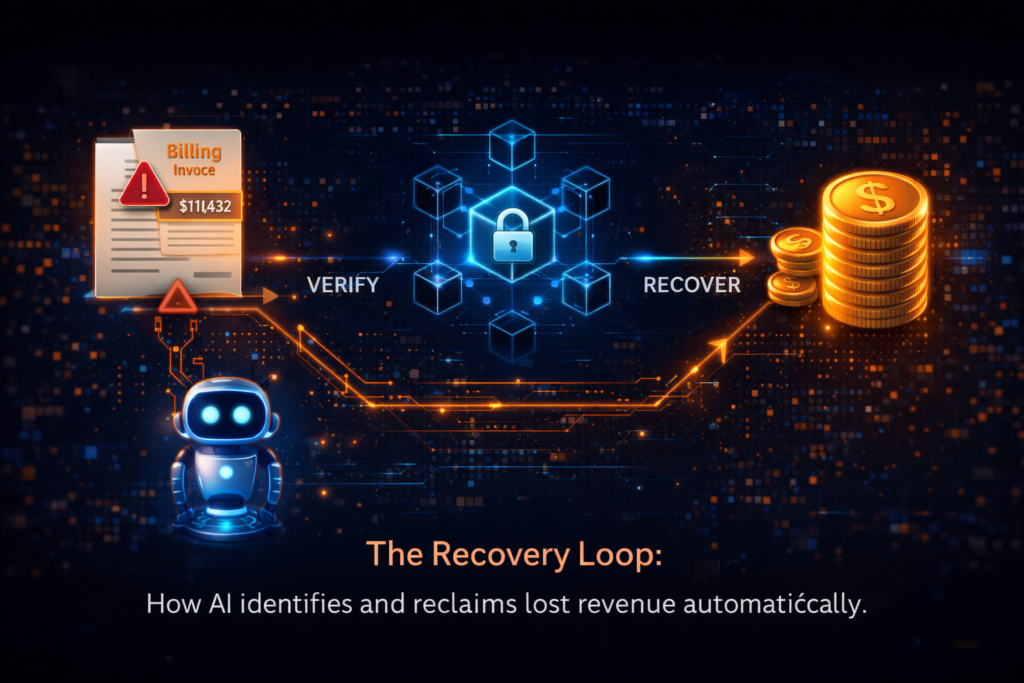
1. Automated Contract-to-Bill Matching
By using AI to read your service agreements, the system ensures that every invoice sent matches the agreed-upon terms. If a client was promised a bulk discount that wasn’t applied, or if an inflation-adjustment clause in a smart contract was ignored, the AI flags the discrepancy before the invoice is even sent.
2. Predictive Churn and Payment Risk
Revenue leakage isn’t just about errors; it’s about missed opportunities. Using AI credit risk models, these agents can predict which customers are likely to default on a payment or cancel their subscription. This allows the business to offer proactive “Retention Incentives” or adjust credit terms before the revenue is lost.
Turning Recovered Revenue into Liquid Capital
The beauty of stopping revenue leakage is that it creates “Found Money.” This is capital that was already yours but was previously invisible.
Boosting Your “Akcache”
Once an AI agent identifies and recovers lost revenue, that capital is immediately swept into your liquidity aggregator. Instead of that 3% leakage sitting in a “dispute” folder, it is now earning 8–12% yield in a stablecoin pool. Over a fiscal year, this compound effect can be the difference between a stagnant company and a market leader.
Enhancing Asset Tokenization
If you are pursuing tokenized RWA, your “Revenue Integrity Score” becomes a major factor for investors. A business that can prove it captures 99.9% of its earned revenue is a much safer bet for fractional investors. High-integrity revenue data can be shared with potential lenders via Zero-Knowledge Proofs, allowing you to secure better rates without exposing sensitive client names.
The Security of Automated Audits
One of the biggest risks of revenue management is “Internal Fraud.” In a traditional system, it is easy for small amounts of money to be rerouted or “misplaced.” In 2026, AI revenue agents provide an immutable audit trail. Every transaction is cross-referenced against your bank feeds, your DePIN sensor data, and your on-chain logs.
This transparency is not just for you—it is for your future buyers. If you ever decide to sell your business or fractionalize your equity, having a “Clean Revenue Log” managed by AI adds a massive premium to your valuation.
Implementing a “Zero-Leakage” Strategy
Starting a revenue integrity program in 2026 involves three steps:
- Connect the Silos: Use API-first agents to link your CRM, your Bank, and your Smart Contracts.
- Define the Guardrails: Tell the AI what an “acceptable” discrepancy is. For instance, “Flag any invoice variance over 0.5%.”
- Automate the Recovery: Empower the AI to send “Smart Reminders” to clients. These aren’t just emails; they are interactive payment portals that offer dynamic discounts for immediate settlement.
Conclusion: Efficiency is the New Revenue
In the competitive landscape of 2026, you cannot afford to leave money on the table. Revenue leakage prevention is the ultimate “low-hanging fruit” for profit optimization. By integrating these AI-driven audits into your autonomous treasury, you ensure that your business remains lean, liquid, and ready for the next stage of growth.
At Akcache, we don’t just help you find new capital; we help you protect the capital you’ve already earned.
