


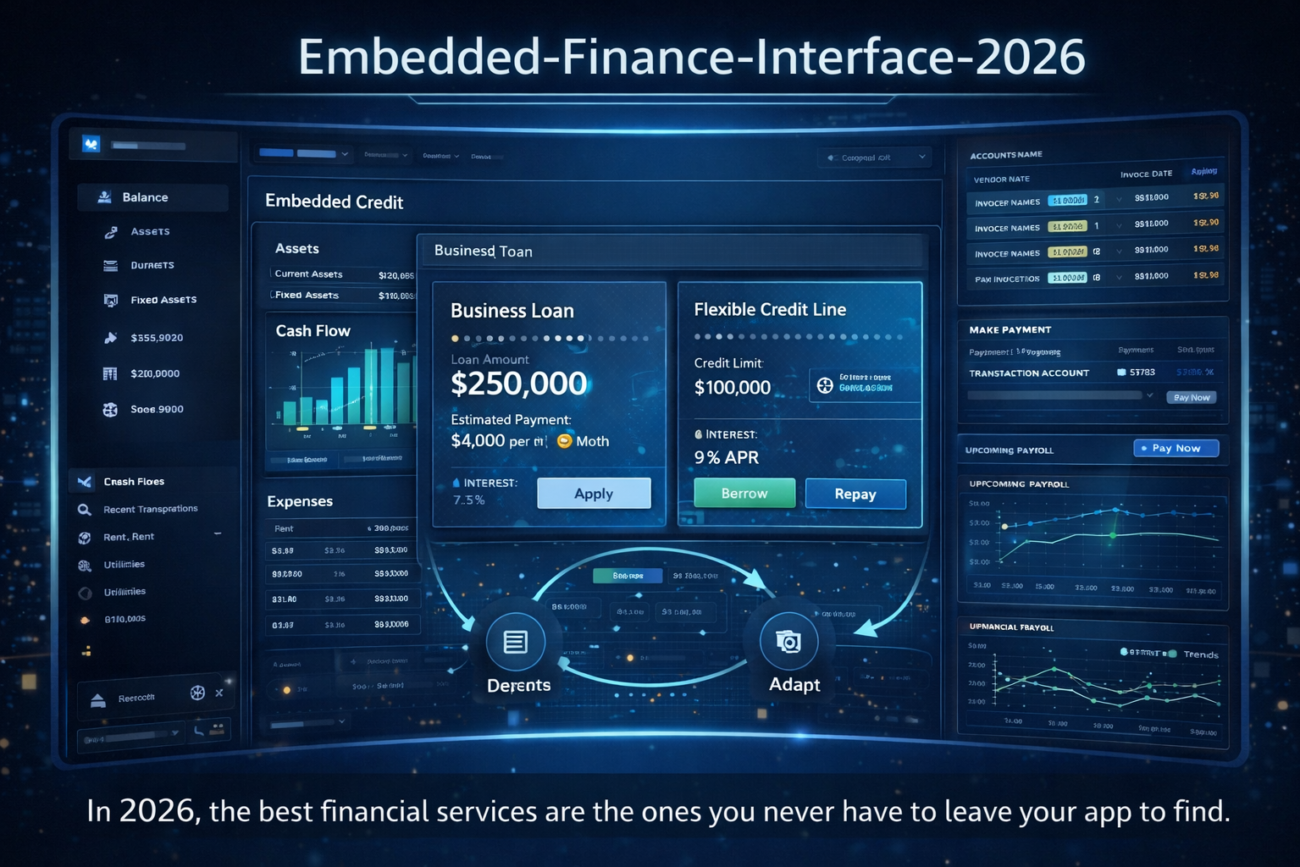
For decades, banking was a destination. If a business needed a loan, it went to a bank. If it needed to manage liquidity, it opened a separate portal. But in 2026, as we have seen with the rise of autonomous treasury management, finance has shifted from a destination to a native feature of the tools you use every day.
This is Embedded Finance 2.0. It is the invisible layer that connects your ERP, your accounting software, and your supply chain management directly to the global liquidity engines we analyzed in our guide on DeFi aggregation.
What is Embedded Finance 2.0?
In its first iteration, embedded finance was about simple “Buy Now, Pay Later” buttons. In 2026, the technology has matured into a sophisticated orchestration layer. Today, your project management software doesn’t just track tasks; it analyzes your progress and offers a contextual business loan the moment it detects a need for more materials.
This “Contextual Banking” relies on the same Agentic FinTech principles we previously discussed. AI agents live within your workflow, monitoring data points to ensure that capital is always available at the exact millisecond it is required.
The Privacy Revolution: Zero-Knowledge Proofs (ZKP)
The biggest barrier to Embedded Finance 2.0 has always been privacy. How can a third-party software offer you a loan without seeing your entire bank history? The answer lies in Zero-Knowledge Proofs (ZKP).
ZKP is a cryptographic method that allows one party to prove to another that a statement is true without revealing any information beyond the validity of the statement itself. For example, you can prove to a lender that your “Akcache” holds over $50,000 without showing them your account number, your transaction history, or your identity details.

How ZKP Protects Your Akcache
By utilizing ZKPs, your business can interact with tokenized RWA platforms and liquidity pools with total “Privacy by Design.” You provide the proof of collateral, and the protocol provides the liquidity. This eliminates the risk of data breaches because the platform never actually holds your sensitive data—it only holds a mathematical proof that your data is valid.
3 Ways Embedded Finance 2.0 Changes Your Daily Operations
1. In-App Liquidity Unlocking
Imagine you are managing a fleet of vehicles. Your logistics software sees that you have $200,000 tied up in vehicle equity. Through RWA tokenization, the software offers to unlock 10% of that value as an instant line of credit for fuel costs. You click “Approve,” and the funds appear in your DeFi cash cache instantly.
2. Autonomous Compliance and Tax
Embedded systems now handle “RegTech” (Regulatory Technology) automatically. When you make a cross-border payment, the embedded ZKP-identity layer confirms you are a verified business entity without exposing your private tax IDs. This speeds up international trade from days to seconds.
3. Smart-Contract Invoicing
Invoices are no longer just PDF documents. In 2026, they are “Smart Invoices.” When a client receives an invoice in their accounting software, the system automatically offers them a discount for early payment or a financing option to pay in installments. All of this is powered by the AI credit risk models running in the background.
The Future: From Apps to Financial Operating Systems
The end goal of this evolution is the “Financial OS.” Your business will no longer “do banking.” Instead, your business will operate within a secure, privacy-preserving environment where capital flows as easily as data.
Whether you are optimizing your autonomous treasury or securing a new line of credit, the process is now invisible, instant, and—thanks to Zero-Knowledge Proofs—entirely private.
Conclusion: Embracing the Invisible
Embedded Finance 2.0 is the final piece of the Akcache puzzle. It takes the complex worlds of AI, DeFi, and RWA and simplifies them into a single, user-friendly click. For the modern entrepreneur, the message is clear: stop looking for a bank, and start looking for a workflow that builds its own bank.
