



For decades, the mark of a successful business was “Ownership.” Entrepreneurs measured their worth by the size of their warehouses, the quantity of their machinery, and the square footage of their offices. But in a global economy that moves at the speed of light, ownership has become a double-edged sword. If your capital is trapped in “bricks and mortar,” you are not an owner—you are an anchor.
The future belongs to the Liquid Business. This is the era where the wall between physical assets and digital capital has finally collapsed. By leveraging the principles of automated CAC optimization and algorithmic tax compliance, elite firms are transforming their static balance sheets into dynamic growth engines.
The Psychology of the Liquid Entrepreneur
The shift toward liquidity is as much a mental revolution as it is a technological one. Traditional finance taught us to “lock away” value for safety. Modern finance teaches us that value is created through movement. When your company’s wealth is liquid, your decision-making changes. You no longer fear market volatility; you embrace it as an opportunity to rebalance. You no longer wait for a bank’s permission to expand; you issue your own tokenized corporate debt. This is the core of the Akcache philosophy: providing the tools that turn “frozen” assets into “flowing” energy.
The Three Pillars of the Self-Sovereign Business
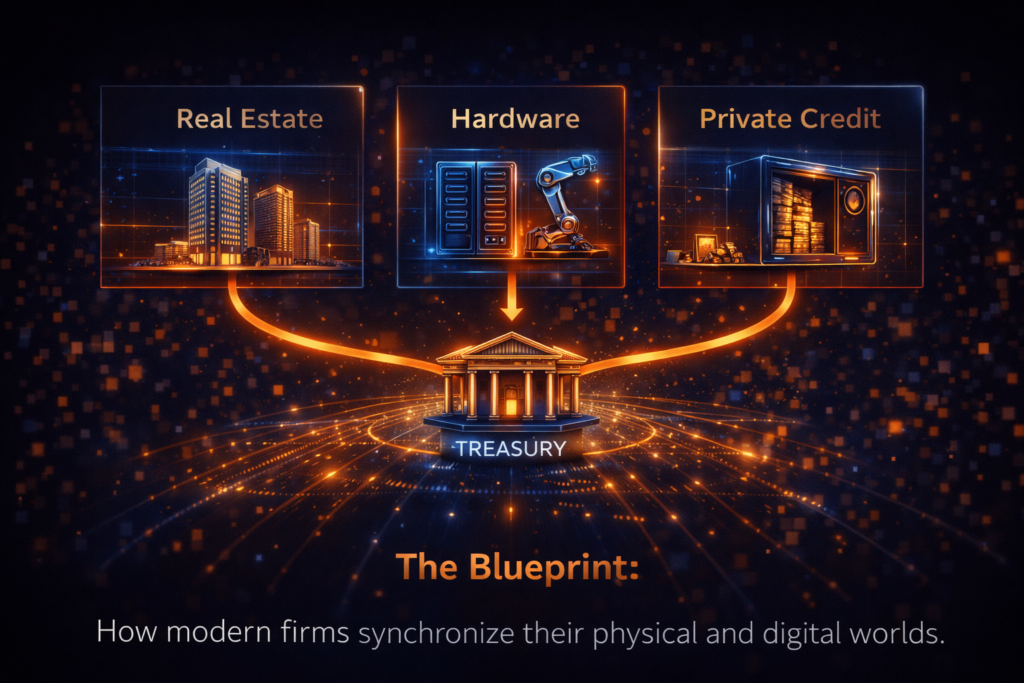
To build a business that is truly borderless and resilient, one must master three distinct layers of the new financial stack.
1. The Infrastructure Layer: Hardware as Revenue
Your physical assets—whether they are delivery fleets, solar grids, or telecommunications nodes—should never be “dumb” hardware. Through the integration of decentralized sensor networks, these assets provide a real-time pulse of your business health. This data is the “Proof of Value” that allows you to secure low-interest business loans without the friction of traditional appraisals.
2. The Equity Layer: Tokenizing the Foundations
Real estate has long been the world’s most illiquid asset class. By moving toward tokenized real estate, you are not just selling a building; you are “programming” your equity. You can sell 5% of your warehouse to fund a new marketing campaign, or use your office space as collateral in a global private credit market. Your property becomes a bank account that you can tap into instantly.
3. The Treasury Layer: Eliminating Capital Latency
The final pillar is the autonomous treasury. This is the brain of your organization. It monitors the “leakage” in your revenue operations and automatically sweeps excess cash into yield-bearing protocols. It ensures that not a single dollar sits idle. In this model, “Profit” is not something you calculate once a year; it is a continuous stream that is optimized every second.
Weaponizing Efficiency: The Competitive Moat
In a world where everyone has access to the same tools, the only sustainable competitive advantage is Efficiency. Consider two identical companies. Company A uses traditional banking, pays its taxes annually, and waits 60 days for its supply chain payments. Company B uses an automated treasury, harvests tax-losses algorithmically, and receives instant liquidity via smart contracts.
Company B is not just “faster”—it is playing a different game. It has more capital to spend on customer acquisition. It can afford to be more aggressive in mergers and acquisitions. Over time, Company B doesn’t just beat Company A; it absorbs it.
The Role of Privacy in a Transparent Economy
As we move toward a fully digital financial system, the “Price of Admission” is often our privacy. However, the next generation of business leaders is demanding a better way.
Through the use of Zero-Knowledge Proofs (ZKP), we can now achieve the “Impossible Trinity”:
- Transparency for auditors and lenders.
- Speed for automated transactions.
- Privacy for your proprietary business secrets.
This means you can participate in a global private credit pool and prove your solvency without ever revealing your specific client list, your margins, or your trade secrets. You remain the master of your own data.
The Horizon: From Business Owner to Financial Architect
When you stop managing “things” and start managing “liquidity,” your role as a founder evolves. You are no longer a manager of people and processes; you are an Architect of Capital. The tools we discuss at Akcache—from debt restructuring to supply chain liquidity—are the building blocks of this new architecture. They allow you to build a business that is resilient to inflation, independent of traditional banks, and ready for an exit at a moment’s notice.
Conclusion: The First Step Toward Sovereignty
The transition to a liquid business does not happen overnight. It begins with a single audit of your current assets. Where is your capital trapped? Where is your revenue leaking? Where is your treasury sitting idle?
By identifying these “friction points” and replacing them with automated, liquid alternatives, you are doing more than just improving your bottom line. You are joining the Liquidity Revolution. You are building a business that is not just built to last, but built to flow.
Welcome to the future of wealth.
